Understanding Insurance and Relationship-Focused Couples Therapy
If you're looking for couples therapy, you may be wondering why my relationship-focused couples therapy is private pay. Insurance and relationship-focused couples therapy use different models, which affects how treatment is defined, documented, and paid for.
How Insurance-Based Therapy Works
Health insurance is designed to cover the treatment of an individual's diagnosed mental health condition. Under this model:
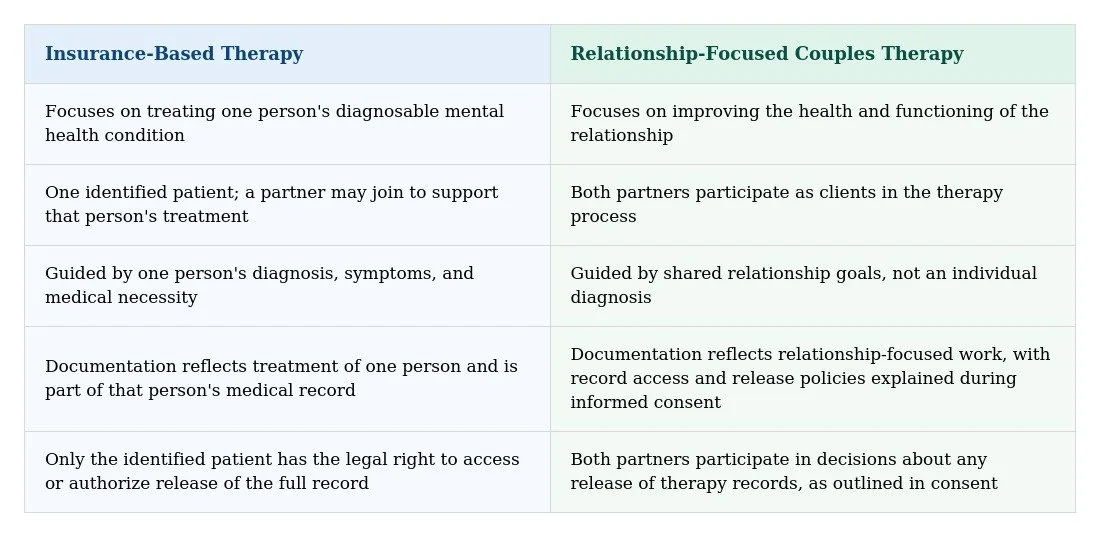
One identified patient. One person becomes the identified patient, and treatment focuses on that person's diagnosis, symptoms, goals, and medical necessity.
Partners may participate. A partner may join sessions to support the identified patient's treatment, not to receive treatment themselves.
Clinical records. The clinical record becomes part of the identified patient's medical record. Their partner does not have the same right of access to that record.
Insurance companies periodically review claims to confirm that documentation supports the billed service and that medical necessity is met under the health plan. When the primary focus of therapy is the relationship, but the documentation describes treatment of one person's diagnosed mental health condition, there can be a mismatch between the services being provided and what insurance is designed to reimburse. Depending on the circumstances, claims may be denied or payments later recouped, with financial responsibility potentially falling back on the client.
What Relationship-Focused Couples Therapy Is
Relationship-focused couples therapy is different. Instead of treating one person's diagnosis, the focus is on the relationship itself: your patterns, communication, conflict, and connection. My role is to remain balanced and accountable to both partners while we work toward shared relationship goals.
Both partners as clients. Both partners participate as clients in the therapy process.
Shared records. We clarify together how records are handled, and both partners are involved in decisions about releasing information, consistent with the informed consent we establish at the beginning.
Relationship-focused care. Because the work focuses on the relationship rather than the treatment of one person's diagnosed mental health condition, I keep relationship-focused couples therapy separate from insurance billing. I also do not "split" this work into individual insurance claims.
Comparing the Two Models
Why My Couples Therapy Is Private Pay
Keeping relationship-focused couples therapy private pay allows the goals of therapy, the therapeutic relationship, the documentation, and the financial arrangements to accurately reflect the work we are doing together. Rather than fitting relationship therapy into a medical model designed to treat one person's diagnosed mental health condition, we can focus on understanding your relationship, strengthening connection, and creating meaningful change together.
Ways to Work Together
Every couple is different. Not everyone needs the same level of support, and not every couple is ready for the same kind of work at the same time.
Private-pay couples therapy is a significant investment, and I think it's important to acknowledge that directly. It's an investment in the relationship itself—in the patterns you want to change, the connection you want to build, and the future you're working toward together.
Relationship Assessment
If your relationship is generally stable but you'd like a clearer picture of your strengths, recurring patterns, and opportunities for growth, a focused relationship assessment can be an excellent place to start.
The assessment includes targeted questionnaires, a feedback session, and a written summary with individualized recommendations you can begin using right away.
Relationship Foundations Program
For couples who are committed to making the relationship work and improving their overall relationship satisfaction, I offer the Relationship Foundations Program—a structured 12-session series designed to strengthen your relationship through psychoeducation, practical tools, and guided conversations.
Together, we'll work to:
Strengthen communication
Better understand recurring relationship patterns
Explore how ADHD, Autism, or other forms of neurodivergence may influence the relationship
Develop healthier ways of navigating conflict, repair, and connection
This program is best suited for couples who are experiencing recurring challenges but are able to stay engaged in the work together. It is generally not the best fit for couples whose conflict regularly spirals out of control or where one or both partners are uncertain about continuing the relationship.
Because the program is structured and time-limited, couples know the expected time commitment and financial investment from the beginning, making it easier to plan both emotionally and financially.
More Intensive Relationship Therapy
Some relationships benefit from a more flexible and individualized therapeutic approach, particularly when conflict escalates quickly, conversations become emotionally overwhelming, or the relationship is experiencing significant instability.
Workshops & Group Offerings
I also periodically offer educational workshops and group programs, including neurodivergent couples workshops and relationship education.
These offerings are designed for education and skill-building rather than treatment for acute relationship distress. Joining my email list is the best way to hear about upcoming workshops and new programs.
A Note on Affordability
I believe quality couples therapy should be as accessible as possible while also maintaining a sustainable practice. I reserve a limited number of sliding-scale appointments for couples experiencing financial hardship. Because these openings are limited, they are currently full through 2026.
If affordability is a significant concern, resources such as Open Path Psychotherapy Collective can be a helpful place to begin your search for reduced-fee therapy. If you pursue that option, I encourage you to confirm that the therapist offers couples therapy and that their approach is a good fit for your relationship.
Choosing the Right Support
My goal is to help you choose the level and type of support that best fits your relationship right now—whether that's a relationship assessment, the Relationship Foundations Program, more intensive couples therapy, or individual mental health treatment.
Understanding the difference between insurance-based individual therapy and relationship-focused couples therapy can help you make a more informed decision about where to begin.
